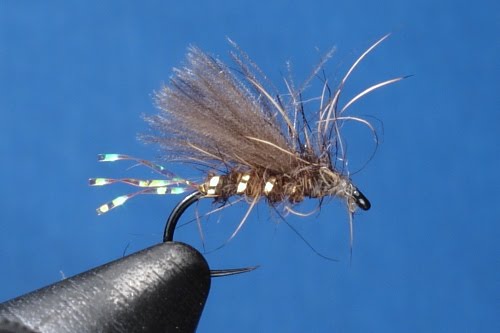
This Saturday I came to an unusual situation on my favorite stillwater: the expected buzzer hatch did not materialize - I suspect sudden change in air pressure, accompanied by drop in temperature of about 15°C was to blame - but some fish never the less were rising. No insect activity was apparent and the fish ignored all my flies: both dark and pale mayflies, caddis flies, beetles and daddy long legs I kept changing in my increasing desperation.
I finally succeeded in provoking a couple rainbows to attack a red & white lure; autopsy showed that the cause of the rises was a fall of rather large aphids, which were carried by wind from surrounding aspen trees. Until then I had no aphid in my fly box, a sad fact I set today to rectify.
The tie:
#20 Hanák 130BL hook (a #22 or #24 hook would be even better, this was the smallest I had)
green Hends body thread for the body
2 layers of lacquer (the buoyant kind, not epoxy)
tip of a CDC feather
17/0 white UNI Trico thread
a light touch of black CD marker
Monday, June 21, 2010
Sunday, June 20, 2010
Summer Olive Dun
Soon it will be time when the Mayfly and Caddis hatches (and hopefully the awfully cold & rainy weather that confined me to the tying table for the weekend) give way to the small pale olives of summer. To this purpose my today's creation: The Summer Olive
The tie:
#18 Hanák 130BL hook
tan UNI 8/0 thread for thorax and head
yellow Hends Grall thread for abdomen
Mole fur dubbing
two smallish CDC feathers
The tie:
#18 Hanák 130BL hook
tan UNI 8/0 thread for thorax and head
yellow Hends Grall thread for abdomen
Mole fur dubbing
two smallish CDC feathers
Tuesday, June 15, 2010
Mayfly Spinner
The time of the Mayfly is here! When the trout key on the danicas no other imitation will suffice :)

The tie:
TMC 109BL #9 Hook
8/0 White UNI Thread
4 Moose mane hairs
Cream UNI floss
black embroidery thread
Polypropylen yarn
Hare dubbing spun in loop
light touch of black marker on head
The best way to fish these is on the margins, where big, fat and lazy fish sit on the edge of current and eddy and wait for the dead and dying spinners that float by in large numbers. Then they feast on them in leisurely pace... yummy!
The tie:
TMC 109BL #9 Hook
8/0 White UNI Thread
4 Moose mane hairs
Cream UNI floss
black embroidery thread
Polypropylen yarn
Hare dubbing spun in loop
light touch of black marker on head
The best way to fish these is on the margins, where big, fat and lazy fish sit on the edge of current and eddy and wait for the dead and dying spinners that float by in large numbers. Then they feast on them in leisurely pace... yummy!
Sunday, June 6, 2010
After very enjoyable trip last weekend I headed North also this Sunday. This time not to Kamenice, but to its bigger sister Jizera. It was my only second fishing trip to the area, but I can already feel it growing on me...

The river was a bit high after recent rains, making wading in hip boots a bigger challenge than I expected. On the other hand it serves me well as a reminder I really should buy new boots for my waders - it is already some time since the old ones finally gave up on me (may they rest in peace in the Happy Wading Grounds).
The faster riffles held - as expected - Brown trout, which could be tempted to rise by my Drowning Caddis imitation.
The slower stretches held Grayling. Some caddis were hatching, but the hatch was very sparse, and Grayling refused the big imitations. A change in tactics was called for, and the finesse approach of #17 No hackle CDC quill on long leader was soon rewarded by a couple of beautifully colored Grayling.


When I exited the stream, having had my fill of Grayling fishing for the day, I encountered two love struck toads. June it is long past their normal mating season, so I can only assume they were doing it for fun rather then procreation ;-)
The river was a bit high after recent rains, making wading in hip boots a bigger challenge than I expected. On the other hand it serves me well as a reminder I really should buy new boots for my waders - it is already some time since the old ones finally gave up on me (may they rest in peace in the Happy Wading Grounds).
The slower stretches held Grayling. Some caddis were hatching, but the hatch was very sparse, and Grayling refused the big imitations. A change in tactics was called for, and the finesse approach of #17 No hackle CDC quill on long leader was soon rewarded by a couple of beautifully colored Grayling.
When I exited the stream, having had my fill of Grayling fishing for the day, I encountered two love struck toads. June it is long past their normal mating season, so I can only assume they were doing it for fun rather then procreation ;-)Sunday, May 30, 2010
Return to Kamenice
The wet and cold days of the early season seem to be past now, what a relief! This weekend I ventured out north to investigate a new fishery that promised an opportunity for wild fish in wild places.
The river Kamenice has a special meaning to me, as I have fond memories (as shown in attached video :-) of it from my whitewater kayaking days.
This time of the year the waters were low and clear, with the rocky bottom clearly visible, and overall looking much tamer. But it was the same river none the less.
The white butterbur flowers were in bloom on the margins, and some grayish mayflies and small Bibios were on wing. Local Brownies were picking them off the surface and could be tempted on a dry fly. The fish were on the smallish side, but obviously locally bred and beautifully colored. Plus they attacked the fly with zest and fought with an attitude.
The color of the fish matched the color of the stream bed perfectly and upon releasing seemed to disappear immediately, despite the seemingly bright yellows and reds.
Later in the day I moved to slower parts of the river, where the brownies were joined by Grayling.
At around 5 o'clock the hatch intensified, and I suddenly found myself standing knee deep in a river, surrounded on all sides by rising fish, oblivious of my presence. Quite an experience! The heavier hatch brought up also the bigger fish, some of them over the 30 cm / 12 inch lenght, making them "decent fish" for the water.
All of my catches were on my Owl and CDC mayfly. It is my first choice for imitating medium gray mayflies, and since it performed so well I found no reason to experiment.
The tie:
#16 Hanák 130BL hook (or any other lightweight dry fly hook, e.g. Tiemco 103BL)
8/0 UNI thread Tan
tail of barred Coq de León fibres
body of a herl from an Eagle Owl feather, reinforced by counter wrapping with the finest copper wire I could find
wing of CDC feathers, spun in loop and wound as hackle, trimmed to size and shape
The river Kamenice has a special meaning to me, as I have fond memories (as shown in attached video :-) of it from my whitewater kayaking days.
This time of the year the waters were low and clear, with the rocky bottom clearly visible, and overall looking much tamer. But it was the same river none the less.
#16 Hanák 130BL hook (or any other lightweight dry fly hook, e.g. Tiemco 103BL)
8/0 UNI thread Tan
tail of barred Coq de León fibres
body of a herl from an Eagle Owl feather, reinforced by counter wrapping with the finest copper wire I could find
wing of CDC feathers, spun in loop and wound as hackle, trimmed to size and shape
Tuesday, May 18, 2010
Střela in time of Ice Men
Messrs. Pankrác, Servác & Bonifác are traditionally referred to as the three Ice Men, as the period around their name days (May 12th, 13th and 14th, respectively) usually coincides with a time of unusually cold days in the Central Europe. This year was no exception, only with the addition that the weather was not only cold but rather wet as well.
In this time I was having a visitor, Fran Friesen from Vancouver, BC, to whom I promised a close encounter with the European Grayling. For this purpose I selected river Střela, where the chance for an off season grayling seemed the most reliable.
My original hopes for a caddis hatch were quickly brought to reality at the sight of the river, which was high and muddy after a recent rain. No hatch was going on and the situation clearly called for a nymphing approach.
Fran introduced me to the Tenkara fishing, which seems to be the next hip thing on the other side of Atlantic. I was rather surprised how easily the rod converted to Czech nymphing tactic - perhaps not what the samurai fishermen intended initially, but very effective.
Later in the day the water cleared a bit and the temperature increased somewhat (to whopping 8°C), which brought up a hatch of smallish mayflies. This allowed us to drop the cumbersome CZ nymphs and start catching grayling as they were meant to be fished - fine and far off on delicate dry flies.
By the end of the day the two of us caught and released some twenty fish, most of them on the dry fly. Given the challenging environment I considered this result a success. The best producing fly turned out to be my Hare's Mask Emerger mayfly imitation.
The tie:
#19 TMC103 BL hook
tan UNI 8/0 thread
three strands of orange Krystal flash
body of Hare's dubbing
#16 UNI Mylar tinsel, color gold
2 smallish CDC feathers
thorax area lightly dubbed with scruffy hairs from Hare's back
In this time I was having a visitor, Fran Friesen from Vancouver, BC, to whom I promised a close encounter with the European Grayling. For this purpose I selected river Střela, where the chance for an off season grayling seemed the most reliable.
My original hopes for a caddis hatch were quickly brought to reality at the sight of the river, which was high and muddy after a recent rain. No hatch was going on and the situation clearly called for a nymphing approach.
Fran introduced me to the Tenkara fishing, which seems to be the next hip thing on the other side of Atlantic. I was rather surprised how easily the rod converted to Czech nymphing tactic - perhaps not what the samurai fishermen intended initially, but very effective.
#19 TMC103 BL hook
tan UNI 8/0 thread
three strands of orange Krystal flash
body of Hare's dubbing
#16 UNI Mylar tinsel, color gold
2 smallish CDC feathers
thorax area lightly dubbed with scruffy hairs from Hare's back
Sunday, May 9, 2010
Return of the Whitefish
I returned to the Bohdaneč fishery & distillery three weeks after catching my first whitefish ever, curious whether my encounter with this unusual fish will be repeated. The spring has proceeded mightily since my last visit, with both apple trees and rapeseed fields in full bloom.
The waters were a slightly muddy from the latest rains (we had an unusually damp and cold springtime this year) but buzzer fishing seemed to be the correct approach. Interesting thing was that the resident rainbows were more interested in light olive buzzers on dropper fished more actively, while the whitefish liked the black buzzer on point fished static, close to bottom.

The sight of the fish had me again wondering what sort of bream had I caught, but strange as it seems the whitefish is indeed a member of the Salmonid family.
The tie:
#10 Kamasan B110 Grub Hook
8/0 UNI thread Black
UNI Stretch Light Olive
Orange Flexi Floss
Two layers of clear varnish
The sight of the fish had me again wondering what sort of bream had I caught, but strange as it seems the whitefish is indeed a member of the Salmonid family.
#10 Kamasan B110 Grub Hook
8/0 UNI thread Black
UNI Stretch Light Olive
Orange Flexi Floss
Two layers of clear varnish
Subscribe to:
Posts (Atom)