
Monday, December 30, 2013
PF 2014
To all my fly fishing & fly tying friends: have a very good 2014 season, and may the slings & arrows of outrageous fortune not keep you away from the stream overmuch...


Saturday, December 28, 2013
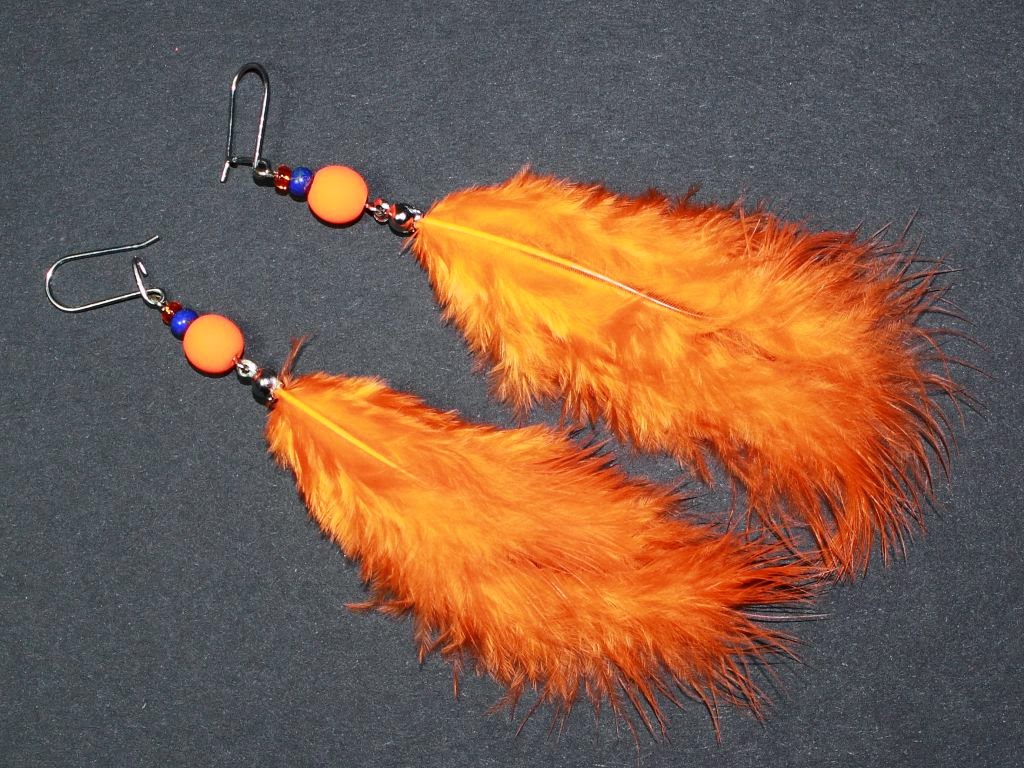
Feathers & Beads, Christmas Edition
At Christmastime a fly dresser can employ his skills in creating some handcrafted gifts to family and friends. It might be even possible to convince the lady of the house that there could be some sensible use for the cache of materials any fly dresser feels obliged to hoard.

The tie:
4 Chicken "marabou" feathers, dyed orange - originally intended for stillwater lures
Hooks and beads from www.koralky.cz craft store.
The tie:
4 Chicken "marabou" feathers, dyed orange - originally intended for stillwater lures
Hooks and beads from www.koralky.cz craft store.
Monday, December 9, 2013
Little Tart (Buchtička)
This little fly has a cult status with many Czech fly fishermen. It consists of only the simplest materials possible - a hook, a bead, hare dubbing, and ribbing of some kind; the tail is entirely optional - but in the hands of a skilled nymph fisherman it has wondrous potential. I have friends who fish this fly (and only this fly) for the whole season with excellent results.
Now with fly fishermen being fly fishermen there are many who just know that their interpretation of the Little Tart is better than others - some swear by gold head, others by dull nickel, and I have witnessed serious bar room fights about what is the "correct" part of the hare's pelt for the dubbing. Or about as serious as bar room fights between fly fishermen ever get...

The tie:
#12 heavy gauge hook (Skalka Lake for me)
3.5mm caliber tungsten bead (dull nickel for me)
rooster hackle fiber tail (not essential, but I like it)
gold tinsel ribbing
hare dubbing (the best is from the back of an old male hare)
Now with fly fishermen being fly fishermen there are many who just know that their interpretation of the Little Tart is better than others - some swear by gold head, others by dull nickel, and I have witnessed serious bar room fights about what is the "correct" part of the hare's pelt for the dubbing. Or about as serious as bar room fights between fly fishermen ever get...
The tie:
#12 heavy gauge hook (Skalka Lake for me)
3.5mm caliber tungsten bead (dull nickel for me)
rooster hackle fiber tail (not essential, but I like it)
gold tinsel ribbing
hare dubbing (the best is from the back of an old male hare)
Monday, November 25, 2013
The Mysterious Case of Vanishing Grayling
For closing of the 2013 seasion I decided to visit the river Střela, which holds a special place in my fishing heart. This is the river on which I discovered the grayling as a game fish years ago and where I smelled my hand after releasing a fish for the first time to discover that peculiar thyme odour.
I was unable to visit the river for some time, but as I had intimate knowledge of the stream from the past I soon recognized familiar pools and started fishing with fly patterns I expected to be of liking to the local fish - I remembered that gold ribbed hare's ear nymph with a tip of orange and a smallish pink gammarus were particullary effective.

To my surprise these known grayling magnets produced: exactly nothing. I was unable to convince a single grayling, despite the fact of catching a number of off season brown trout. The occasional brownie was sort of expected, but the total absence of grayling was puzzling me deeply.
After persevering for some time I proceeded to catch a couple more brownies, but the grayling remained conspicious by their absenece.

I did not wish to disturb the brownies - who by the look of their mating colors had obviously other things on their mind - too much and as no grayling seemed to be in sight I retired home early.
Still puzzled after cutting my last season's outing short I made some inquiries on the health of the local grayling population. My fears were confirmed by a local friend, who confirmed that the grayling have indeed vanished from upper Střela following heavy floods. Their absence was confirmed by electrofishing. Their disappereance could not be even traced to the cormorants, as is the case with some other Czech rivers suffering decline in fish numbers - the Grayling simply were there in the winter and were gone after the spring floods.
As I have very fond memories of fishing this river as a young novice of the dark art of Grayling fishing I sincerely hope that this fish, being short lived species with good population dynamics, recovers from this setback and returns to the river where they were once flourishing.
I was unable to visit the river for some time, but as I had intimate knowledge of the stream from the past I soon recognized familiar pools and started fishing with fly patterns I expected to be of liking to the local fish - I remembered that gold ribbed hare's ear nymph with a tip of orange and a smallish pink gammarus were particullary effective.
To my surprise these known grayling magnets produced: exactly nothing. I was unable to convince a single grayling, despite the fact of catching a number of off season brown trout. The occasional brownie was sort of expected, but the total absence of grayling was puzzling me deeply.
After persevering for some time I proceeded to catch a couple more brownies, but the grayling remained conspicious by their absenece.
I did not wish to disturb the brownies - who by the look of their mating colors had obviously other things on their mind - too much and as no grayling seemed to be in sight I retired home early.
Still puzzled after cutting my last season's outing short I made some inquiries on the health of the local grayling population. My fears were confirmed by a local friend, who confirmed that the grayling have indeed vanished from upper Střela following heavy floods. Their absence was confirmed by electrofishing. Their disappereance could not be even traced to the cormorants, as is the case with some other Czech rivers suffering decline in fish numbers - the Grayling simply were there in the winter and were gone after the spring floods.
As I have very fond memories of fishing this river as a young novice of the dark art of Grayling fishing I sincerely hope that this fish, being short lived species with good population dynamics, recovers from this setback and returns to the river where they were once flourishing.
Monday, November 18, 2013
The Belgian & Orange micro
With the Czech salmonid season fast approaching its end there is just about enough time for a dramatic finish, before I retire to my tying den to contemplate the 2014 season.
In late November it is unreasoneable to expect any hatch, and even though hope springs eternal - and unlikely is not the same as impossible - it is reasoneable to prepare for a season finish in the nymph fishing style.
For this opportunity I prepared two dressings: one is new for me, of pattern well liked in the competition fishing circles and introduced to me by Slovak master tier Peter Durišík, and the other is a long time favorite of mine.

The Belgian / Belgičanka:
#16 Hanák 130 BL hook
2.5mm tungsten bead, copper plated
prominently orange Danville's thread, 70 dernier
pheasant tail body
counterribed by copper wire

Orange tipped micro nymph:
#18 Hanák 130 BL hook
2.0mm brass bead, gold plated
4 strands of orange Glo Brite floss
red fox dubbing body
ribbed with 1/32" (i.e. rather thin) gold tinsel

In late November it is unreasoneable to expect any hatch, and even though hope springs eternal - and unlikely is not the same as impossible - it is reasoneable to prepare for a season finish in the nymph fishing style.
For this opportunity I prepared two dressings: one is new for me, of pattern well liked in the competition fishing circles and introduced to me by Slovak master tier Peter Durišík, and the other is a long time favorite of mine.
The Belgian / Belgičanka:
#16 Hanák 130 BL hook
2.5mm tungsten bead, copper plated
prominently orange Danville's thread, 70 dernier
pheasant tail body
counterribed by copper wire
Orange tipped micro nymph:
#18 Hanák 130 BL hook
2.0mm brass bead, gold plated
4 strands of orange Glo Brite floss
red fox dubbing body
ribbed with 1/32" (i.e. rather thin) gold tinsel
Sunday, November 10, 2013
Crane Goldhead
This is a fly from the Bandits category - named after Hrajnoha and Uhorčík, two legendary folk heroes from Slovakia. It is a style that has served me well over the years.
Normally I make the shortish body of hare's fur, but to make it more interesting this time I used a herl section of a crane feather. It adds a nice contrast to the green butt and gold tinsel. The collar / thorax is from a home made mix of hare and fox squirrel - plain fox squirrel just does not seem to stick to my thread, but it becomes much more pliable when mixed with some hare in a coffee grinder.

The tie:
#10 Kamasan B160 heavy short shank hook (debarbed)
3,3 mm gold tungsten bead
tan elastic tying thread
red rooster hackle fibres for tail
elastic fluo green floss for tag
gold Gütermann tinsel (counterwrapped)
herl from a crane feather
fox squirrel / hare dubbing collar
Normally I make the shortish body of hare's fur, but to make it more interesting this time I used a herl section of a crane feather. It adds a nice contrast to the green butt and gold tinsel. The collar / thorax is from a home made mix of hare and fox squirrel - plain fox squirrel just does not seem to stick to my thread, but it becomes much more pliable when mixed with some hare in a coffee grinder.
The tie:
#10 Kamasan B160 heavy short shank hook (debarbed)
3,3 mm gold tungsten bead
tan elastic tying thread
red rooster hackle fibres for tail
elastic fluo green floss for tag
gold Gütermann tinsel (counterwrapped)
herl from a crane feather
fox squirrel / hare dubbing collar
Wednesday, November 6, 2013
Dark Olive & Claret Bobeš
The recent trip has put a dent in my Bobeš box, so a resupply tying session was in order.

This color combination is not as popular with Czech fly fishermen as the medium olive with red accent, but it got me some very fine fish.

The tie:
#8 Gammarus hook
a layer of flat lead
light cream tying thread
brownish scud back ribbed with 0.16 mm spinning mono
body of rabbit fur dyed brown olive
thorax of mohair dyed claret and black
a light finishing touch with black CD marker
This color combination is not as popular with Czech fly fishermen as the medium olive with red accent, but it got me some very fine fish.
The tie:
#8 Gammarus hook
a layer of flat lead
light cream tying thread
brownish scud back ribbed with 0.16 mm spinning mono
body of rabbit fur dyed brown olive
thorax of mohair dyed claret and black
a light finishing touch with black CD marker
Subscribe to:
Posts (Atom)